
What Do Colleges Usually Need to Accept a Homeschool Transcript?
Blog post description.
The Savvy Homeschooler
6/3/20263 min read
What Do Colleges Usually Need to Accept a Homeschool Transcript?
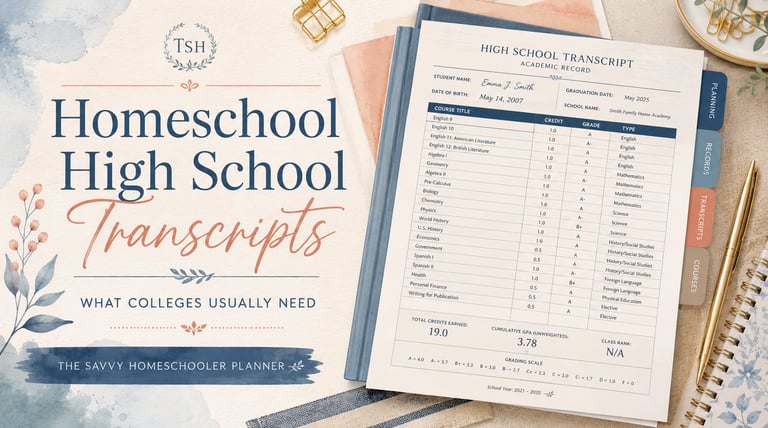
Creating a homeschool high school transcript can feel intimidating at first, but it does not need to be complicated. Most colleges are not looking for something fancy. They are looking for a transcript that is clear, complete, organized, and easy to read.
A homeschool transcript is simply a one-page academic record that shows what your student completed during high school, the credits earned, the grades received, and the final GPA.
For homeschool families, the parent is usually the school administrator, guidance counselor, teacher of record, and transcript preparer. That means it is important to keep the transcript professional, accurate, and consistent.
What Should Be Included on a Homeschool Transcript?
Most colleges will want to see the basic student and school information at the top of the transcript. This usually includes:
Student’s full name
Date of birth
Homeschool name
Homeschool address
Parent or administrator name
Expected or final graduation date
The transcript should also include a clear list of high school courses completed during grades 9–12. These can be organized by school year or by subject.
Each course should include:
Course title
Credit earned
Final grade
Grade points, if used
School year completed
Colleges will also expect to see the student’s total credits earned and cumulative GPA. Including a grading scale is also helpful because it explains how grades were calculated.
Do Homeschool Transcripts Need to Be Accredited?
In most cases, a homeschool transcript does not need to come from an accredited school in order to be accepted by a college. However, colleges do want to understand what the student studied, how the student was graded, and whether the student completed the required coursework for admission.
This is why clear course titles, credit totals, GPA, and a grading scale matter.
For example, instead of listing a vague course title like “History,” it is better to list a specific course title such as “U.S. History,” “World History,” or “American Government.”
What About Outside Classes?
If your student took a class through a public school, private school, online school, community college, Running Start, or dual enrollment program, it is important to keep records from that school.
You can list transferred credits on the homeschool transcript, but colleges may also require official transcripts directly from the outside school or college.
This is especially important for college courses, dual enrollment, Running Start, or any class that was completed through another institution.
A good rule of thumb is this: if another school or program awarded the credit, request a transcript from that school and keep it with your records.
Should Test Scores Be Included?
Test scores are sometimes included on a transcript, but they are usually optional. Some families like to include SAT, ACT, CLT, AP, or other test scores on the transcript, while others leave them off and submit scores separately if needed.
If the college is test optional, test scores may not be required. If the student has strong scores, including them may be helpful. If the scores are not needed, that section can usually be left blank or removed.
Should Honors and Activities Be Included?
Honors and activities can be included on a transcript, but they do not have to be. Some families prefer to keep the transcript focused only on academic coursework and then create a separate resume or activities sheet.
If your student has awards, volunteer work, leadership roles, jobs, ministry involvement, sports, music, or other activities, a separate student resume may give you more room to describe those experiences well.
Should I Keep Course Descriptions?
Course descriptions are not always required, but they are helpful to have ready.
A course description usually explains what the student studied, which books or curriculum were used, how the grade was earned, and what skills were covered. This can be especially helpful for selective colleges, scholarships, NCAA eligibility, military academies, or any school that wants more detail about a homeschool course.
Even if you never submit course descriptions, keeping them in your records gives you a stronger paper trail.
What Makes a Homeschool Transcript Look Official?
A homeschool transcript should be neat, consistent, and easy to read. It should not look like a rough worksheet or personal notes page.
A college-ready homeschool transcript should include:
A clean one-page layout
Clear course titles
Credits and grades
GPA and total credits
Grading scale
Graduation date
Parent/administrator signature
Date signed
The parent or homeschool administrator should sign and date the transcript before submitting it.
A Helpful Transcript Option
I have also included an editable Excel homeschool transcript inside The Savvy Homeschooler Planner for families who want their high school records to stay connected with their homeschool planning system.
The transcript is also available separately for families who only need a simple, polished way to create and print a homeschool high school transcript without purchasing the full planner.
Final Thoughts
Homeschooling high school does require good recordkeeping, but it does not have to be overwhelming.
The most important thing is to keep your student’s records clear, accurate, and consistent. Colleges are used to reviewing homeschool transcripts, and a well-organized transcript helps them understand your student’s high school work at a glance.
If your student has outside credits, keep those official transcripts. If your student has unique courses, keep course descriptions. And if you want the final transcript to look polished, use a clean template that calculates credits and GPA for you.
High school records matter, but creating a homeschool transcript does not have to be complicated.
Contact
Newsletter
support@thesavvyhomeschooler.com
© 2024. All rights reserved.